
Why Roofers Lose Money Between Approval and Final Invoice


Getting an insurance claim or scope approved feels like crossing the finish line, doesn’t it? The adjusters have signed off, the homeowner is on board, and the build is finally scheduled. You might even feel a little relieved, thinking the hardest part is behind you.
But here’s the reality: that approved estimate isn’t the finish line at all—it’s just the starting line. In fact, this is where the real work (and risk) begins for most roofers.
From the day your job is approved until the final invoice goes out, thousands of dollars can quietly slip away. It’s not usually one big mistake that drains profits—it’s the small stuff. Maybe your crew finds unexpected water damage but forgets to snap a photo before making repairs, so you can’t bill for the extra labor and materials. Or maybe there’s waste in material handling, a missed change order, or a supplier invoice that doesn’t get double-checked. None of these slip-ups seem huge on their own. But lose $300 on decking here, miss a change order there, and pay for a material overage nobody caught—by the end of the month, you’ve given away thousands of dollars without even realizing it.
The Core Problem: The Gap Between Approval and Reality
The initial estimate is based on what you can see before the job starts. Tear-off is when you find out what you’re actually dealing with:
You uncover rotten decking.
You need to replace the drip edge to meet local building codes.
The requirements for ice and water shielding differ from the original estimate.
You discover a second layer of shingles during tear-off.
If you don’t record, document, and charge for these field conditions, your company ends up eating the cost—even when you’re adding real value for the homeowner.
4 Common Profit Leak Points in Roofing Production
1. Forgotten or Unbilled Extra Items
When your team finds extra code items or unexpected damage, they’ll usually handle it right away to keep things moving. That’s great for the homeowner—but not so great for your bottom line if nobody logs the change. If you don’t snap a photo before covering it up, good luck getting the carrier to approve it later.
2. Missing Photo Documentation
No photo, no proof. Without proof, getting an adjuster to support and approve the extra decking, flashing, or starter later becomes a much harder conversation.
3. Material Supplier Invoice Problems
Material costs vary, and supplier invoices often don't match the initial estimate. When you pay invoices without carefully comparing each item to what you actually used on the job, the supplier may have charged more than expected. Maybe you ordered too much material, paid a delivery fee nobody caught, or never credited the bundles that came back. A few hundred dollars here and there adds up fast.
4. Inaccurate Final Billing
Too often, contractors just resend the first estimate as their final invoice. But the final invoice should tell the real story of what happened on the jobsite—not just what was on paper weeks earlier. If you stick to the original approvals, you’re missing out on legitimate expenses for labor, materials, and code compliance that you’ve already paid out of pocket.
The Solution: A System of Documentation Discipline
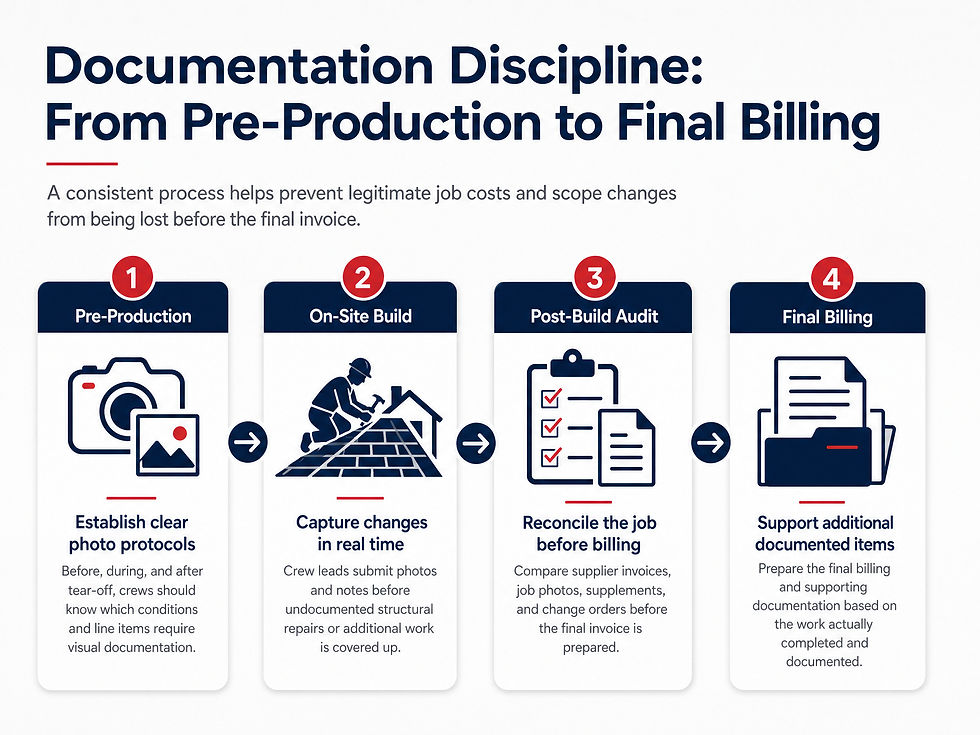
So how do you plug these profit leaks? Start with simple, actionable systems that make it easy for everyone to do the right thing. For example: set up a rule—if the crew finds something that costs extra, they take photos and send it to the office before the repair gets covered up. Use digital platforms that let project managers upload updates in real time so that the billing team can jump on change orders right away. The system doesn’t have to be fancy—just consistent. You shouldn’t have to play detective weeks after the job wraps up.
Closing the Gap
It’s not about hiring more people or making things more complicated—it’s about making sure you actually get paid for the value you deliver. By improving field documentation, tracking every change order, and double-checking the books before invoicing, you can finally make your hard work pay off.
This is also where having the right system matters. Veristra helps production and back-office teams keep job photos, material information, supplements, and scope changes organized within the contractor’s existing workflow or CRM. Instead of trying to reconstruct what happened weeks later, your team has the documentation while the work is still fresh—and before the final invoice goes out.


Comments